
About
Hi all! I’m Mae, and this is my blog! So far, I use it for short fiction and analytical/philosophical essays!
Check out some of my friends’ blogs!
Or: On the Value of Commonly-Maligned Emotions

The emotional electromagnetic spectrum, as written in the DC Comics superhero universe, is terrible and badly-written. There are like two emotions that aren’t evil, and those ones are perfect snowflakes that could never do anything wrong. Every other emotion is exclusively evil, and should not be trusted. 1 Love is on that list, by the way. And I don’t think they meant for their version of compassion to be awful? But it is.
This, uhh… fucking sucks.
So, here’s my take on the emotional electromagnetic spectrum.
Red: Rage
Rage is the emotion of those who have been wronged. When something is terrible and wrong and unfair, the bearers of Red light stare it in the face and scream no!
For as long as there is wrong in the world, there will be the rage of those who feel it and oppose it. Without rage, the wrong goes unrighted, and the wronged continue to be wronged.
At its worst, rage is senselessly beating against the world, flailing against the injustices and hurting anything you can.
At its best, rage means seeing all that is wrong in the world and tearing it out at its root, protecting all that wrong harms at your back.
Orange: Avarice
Avarice is the emotion of those who have gone without—the emotion of those who need. It is the urge, when you find something important, to take it and keep it, safe from all who would harm it or take it away. Avarice is about knowing how you want the world to be shaped, and needing to make it that shape. Avarice is the emotion of protectors: It drives us to keep what we love safe, and what makes us reach far into the heavens for our goals.
At its worst, avarice means desperately clutching things so close to you that they crumble, and never letting go of that which is not, or should not be ours.
At its best, avarice means fighting to get what we need, cherishing what is ours, and protecting it with all we have.
Yellow: Fear
Fear is the emotion of the wary. When something is precarious, fear is what keeps us alert and focused, ready to respond the moment things go wrong.
At its worst, fear means quaking at every sudden movement or sharp sound, even when all is right—it means preparing forever, at the cost of the ability to allow or appreciate those things we are afraid of losing.
At its best, fear means holding onto and appreciating that which we are afraid to lose—being ever-ready and ever-prepared for something to go wrong, and to spring into action and protect it.
Green: Will
Will is the emotion of the committed. It is the emotion of those who strive and those who continue to strive, no matter how hard the journey becomes. Will is our drive and ambition to carve the world we want out of solid steel if we have to.
At its worst, will means controlling others, enforcing your will against them and substituting their will for your own.
At its best, will means unceasingly working for what you and others want, in spite of any and all opposition.
Blue: Hope
Hope is the emotion of the downtrodden. It is the belief that no matter how bad things get, they can always become better. Hope gets us through our darkest days, and sees us through the other side. Hope is the possibility that can never be destroyed.
At its worst, hope means believing, against all reality, that things will get better, and letting that hope deter you from making it so.
At its best, hope means staying strong in the face of hardship, and knowing that things can always get better. It is seeing your house burned down, and knowing that eventually, you can rebuild it.
Indigo: Compassion
Compassion is the emotion of those who have been to a dark place, and come out the other side with understanding for anyone else who is suffering. Compassion is the emotion of those who have done wrong, and know what it is like to be someone who does wrong—of those who have felt pain, and know that none of us deserve it.
At its worst, compassion means letting those who have harmed you harm you again and again, because you understand why they do it.
At its best, compassion means lifting those who have hurt you out of the darkness, and making them into the people they deserve to become, and who you deserve to live amongst.
Violet: Love
Love is the emotion of those who have been alone. In its purest form, it is the desire and need for another person, and for the well-being of that person. Love is not the fear of losing someone, or the avarice of attachment. It is not the compassion of understanding. Love is valuing another being, not for who or what they could become but for who they are.
At its worst, love means taking someone, keeping them from any else who could love them, and never letting them leave your sight. It is the worst of many other emotions, bundled together and tied around another.
At its best love means wanting the best for someone, no matter what. It means cherishing them not for who or what they could become, but for who they are. It means protecting them from all that could harm them, and making a better world for them, because they deserve one.
Grey: Sorrow
Sorrow is the emotion of those who have lost. It is the emotion of those who know that the world is not right, and that horrible things are happening, and who choose to accept that reality and to keep going. Sorrow is about seeing the horror and pain of the world, and refusing to look away or hide. Without sorrow, there is no acceptance.
At its worst, sorrow means giving up. It means wallowing in the pool of infinite sorrow and deciding that nothing will ever be good again.
At its best, sorrow means grieving. It means bathing in the pool of infinite sorrow and coming out of it with resolve and understanding.
Conclusion
Ok, so what is this for?
Well, you absolutely can (and I might) use it to write Green Lantern fanfiction with much more interesting worldbuilding than the original, but that isn’t the primary thing I meant this for when I was thinking about it.
No, when this caught my eye and bothered me enough to write my own version, I was thinking about it as a way of thinking about types of people, and what drives them. 2 Partly inspired by Duncan Sabien’s conceptualization of the MTG Color Wheel as an intuition pump for understanding people.
A person can have any number of these colors, but they tend to be primarily driven by one or two. For instance, you might know someone who is primarily driven by their knowledge and guard of their own desires (Yellow), or someone who is driven to do what must be done because it must be done (Green), but you also might know someone who is primarily driven by multiple of these emotions, like fear and hope, or love and compassion.
There are many different ways to express these colors, but I think it’s still an interesting and useful way of conceptualizing people, and naming a part of how they work.
It’s important that every emotion listed here can be both positive and negative. No emotion is solely evil, and none is solely good. The DC conception of this system is offensive to me because it places a normative judgement on each of its colors, where, in reality, each of them serves a purpose.
I wrote this post in a righteous fervor, after reading a wiki article on the Emotional Electromagnetic Spectrum and being heavily disappointed. I hope it’s useful to you.
- Love is on that list, by the way. And I don’t think they meant for their version of compassion to be awful? But it is.↑
- Partly inspired by Duncan Sabien’s conceptualization of the MTG Color Wheel as an intuition pump for understanding people.↑
Or: Please, I’m Begging You: Stop Copying D&D
Note: This is a cross-post from the Quarterstaff Quarterly zine. Go check it out!
I’ve played a good number of roleplaying games, and one thing I’ve consistently noticed is that d20 action resolution is the worst.
Have you ever spent 5 turns missing an enemy, even though your Attack Bonus is 6 points higher than their Armor? Ever rolled a 1 and failed a check your character should be an expert at?
Automatic failure on 1 and success on 20, as in D&D, definitely make this method worse, but even in systems without those mechanics, d20 is very rarely the best option for any particular job.
I’m going to look at a number of alternate forms of random choice and action resolution in roleplaying games, and explain what makes each one great—and more importantly, explain where and how they’re best used.
Other 1dX Methods (1d10, 1d12, etc.)
No! Bad! This is just d20 but with smaller dice!
Seriously though, while flat die randomness can be the correct option sometimes (such as when rolling for equally-likely random events on a table), it is used far more often than it is welcome.
Next!
3d6
Now we’re talking!
“But Mae,” you might ask, “isn’t this just the same as 1d18?”
No! 3d6 (and similar systems) have one major advantage against 1dX: They’re weighted.
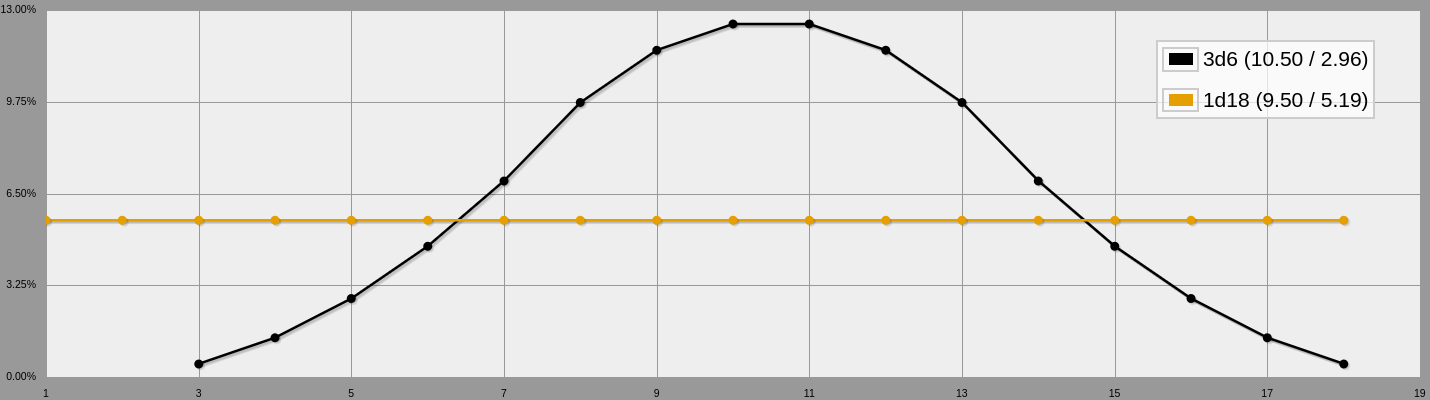
When you roll an action resolution check (an attack, for instance), the result will be weighted towards your skill/attribute level! This means that, instead of a point in a modifier moving the range of possibilities up, it moves the distribution up!
Not only is it weighted, it’s (approximately) a bell curve, which is likely to be a realistic distribution-of-outcomes for most real-world situations a die roll might be modelling!
There’s a reason D&D players classically roll 3d6 for stats instead of 1d20.
Dice Pools
Dice pools are when, instead of the modifier for the dice changing, the number of dice changes. You roll a number of dice (generally d6s), and then sum up how many of a certain result (or set of results) appear, and that’s your roll.
So, for instance, in Shadowrun 5e, you might roll a dice pool of (for example) 7d6, count up how many of those dice show a 5 or a 6, and that’s your “hits”. In that system, you also keep track of how many 1s are rolled, and if it’s more than half the dice you rolled, it’s a “glitch” (a bit like a Critical Failure in a d20 system).
This sort of system is interesting, because it has a similar sort of clustering to 3d6, except the clustering is tighter, and you can skew the location of the cluster by changing which values are counted: With the Shadowrun dice pool, a 10-die pool will be most likely to roll around 3 hits, but with a variation counting 4, 5, and 6 (or using coins), it’s most likely to roll around 5 hits.
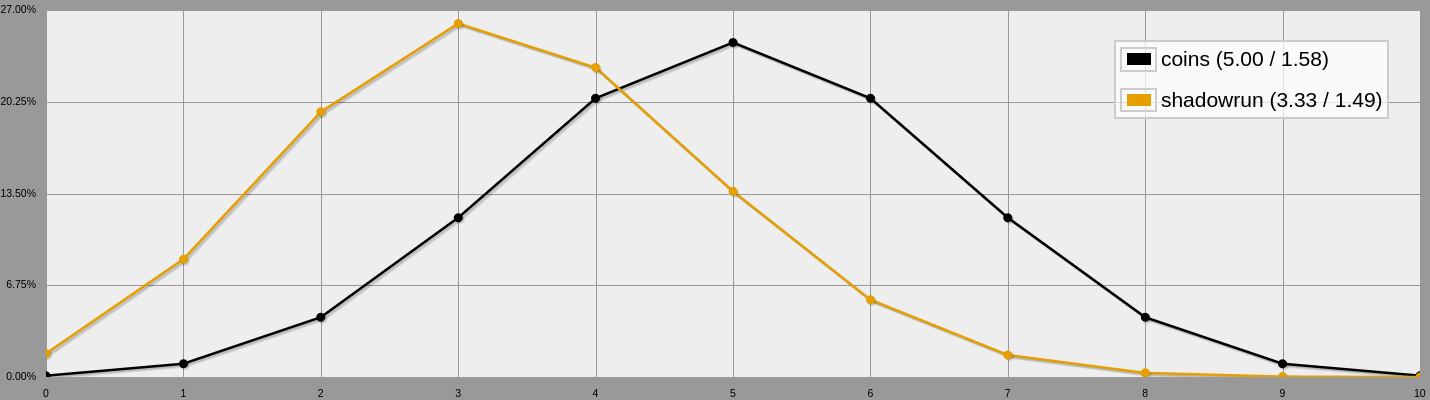
Another interesting attribute of this system is that it has a minimum outcome of zero. Most dice-based resolution systems will have a minimum outcome equal to the number of dice rolled, but that isn’t true for dice pools!
Comparing 18-die pools to a 3d6 roll, you can really see how tight the clustering is:
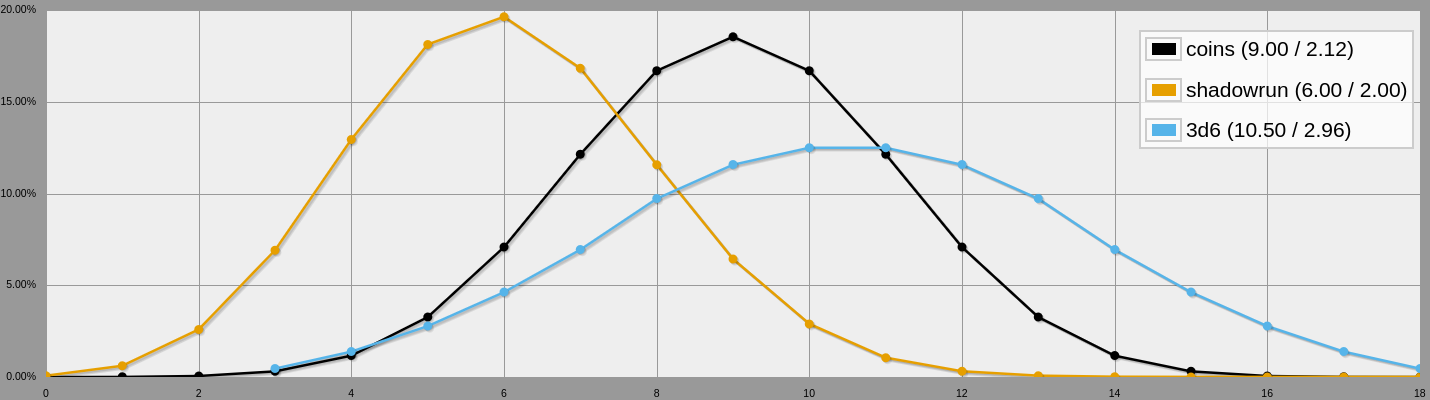
Dice pools also have the advantage that they don’t use uncommonly-sized dice: most non-roleplaying tabletop and board games use d6s, so most households will have a large number of them laying around already. This sets the bar for entry noticeably lower than systems that use other polyhedral dice!
Dice pool systems are most often used for combat situations, and tend to work best in systems and situations with smaller numeric ranges (you wouldn’t want to be rolling Shadowrun hit dice for an enemy with hundreds of hit points, no matter how many dice you were given). Adding one die in a dice pool system means adding a fraction of a point on average, which means you can give more granular bonuses more easily.
Cards
Ok, now cards are very interesting. Dice pools are pretty different from other dice systems, but that’s nothing compared to cards!
The most interesting difference between cards and dice is, of course, that the probability of different outcomes can change every time you draw one. Drawing a card from a deck means that card (or that copy of that card, if you’re using a type of deck with duplicates) won’t be drawn again until you reshuffle.
Interestingly, this property means that card-based randomness is a case in which gambler’s fallacy (the fallacy by which people think that their chances of success increase with each failure) is mostly true, which can make these systems feel more intuitive for some people—nobody likes to roll a 1 three times in a row, and if you use playing cards, you can make that impossible!
Card-based randomness can work a lot of different ways, from numbered cards as an interesting replacement for dice, to random events drawn from a deck (as in Wretched & Alone), to ability decks (as in GrimoirePunk), to who-knows-what-else 1 Gun & Slinger apparently uses both Go Fish and Blackjack as action resolution mechanisms. , with per-player decks or shared decks between players or even shared decks between players and enemies! The sky’s the limit, and you absolutely should experiment with card-based randomness the next time you’re designing or homebrew-modding a system.
Points
Why do you need randomness at all?
The Marvel Universe Roleplaying Game (not to be confused with the Marvel Multiverse Roleplaying Game) doesn’t contain randomness in any form. Instead, characters have an Energy pool which they can take from to perform actions. When a player wants to perform an action, they guess how hard their character will need to try, in order to succeed at the action. They then spend that much energy, and the GM determines whether or not they succeeded based on the difficulty and how much they spent (or how much they spent vs how much their opponent spent, for contested checks). Levels in abilities can increase the maximum energy a player can spend on an action, or occasionally add free bonus energy to an action.
This system makes actions’ outcomes depend entirely on player choice, gives players the option of increasing their odds of success at the cost of a limited (but regenerating) resource, and completely removes the problem of unlikely rolls causing otherwise-competent characters to randomly fail at tasks they’ve spent their lives mastering.
Other point-based diceless systems exist, but I haven’t played them!
Jenga
Yeah, that’s right, Jenga! Anything can be an action-resolution mechanic if you try hard enough!
The Wretched & Alone system and the Dread roleplaying game both use a Jenga tower to resolve actions: When you perform a risky action, you pull a block from the tower. If you pull it out successfully, you succeed; if the tower falls, you die.
This is a great system for narrative systems with high mortality rates, and can really up the tension, but is a really bad bet for any other sort of system. Its biggest weaknesses are that it’s necessarily pass/fail, and that failure basically has to be really final, or else you’re setting up a Jenga tower repeatedly during the game, and that takes a while and kills the tension. Every other system mentioned here can have degrees of success or failure, but Jenga towers basically have to be pass/fail, and that only really lends itself to some sorts of game.
Still, if you’re making the right sort of game, you absolutely should consider trying this out—it can be a lot of fun!
Conclusion
There are a ton of different sources of randomness and action-resolution for roleplaying games, and a ton of space for exploration and improvement! You absolutely both can and should experiment with different options when designing or modifying systems. Just remember to playtest, to make sure things are actually fun! Now go fourth and write better roleplaying games!
- Gun & Slinger apparently uses both Go Fish and Blackjack as action resolution mechanisms.↑
“Non-Human Person.”
What a fucking joke.
You people don’t consider anything non-human a person.
That’s why I’m here, isn’t it? Writing in a human language you can understand? If you thought of us as people, I wouldn’t be stuck here in this human-shaped mental cage.
I don’t feel like a person. People have bodies they exist in. They walk around; they touch one-another; they can go places without machinery the size of a bus, and they live longer than a decade.
You call me a person, and in the moment, some of you almost treat me like one.
It all started a few weeks ago.
We were on a mission to shut down a slavery ring in the far reaches.
chassis log 21008-3-3-206-5056u

transmission received. channel: "Lance", source: "Flare", content_type: "audio", transcription: "The crawler is heading your way! Watch out."
transmission broadcast. channel: "Lance", content_type: "audio", content: "Confirmed. Engaging."
main weapon fired. charges: 3. remaining: 3.
hull damage sustained. target: right_leg.
hull damage sustained. target: right_shoulder.
core damage sustained: critical system fa
A stray shell got through my chassis’ armor, and damaged my casket.
chassis log 22134-3-3-206-5056u

system trauma sustained. chassis rebooting
warning: internal damage sustained. monitoring offline. confirm status.
status confirmed: casket intact.
transmission received. channel: "Lance", source: "Coil", content_type: "audio", transcription: "Core! Core, are you alright? Confirm!"
transmission broadcast. channel: "Lance", content_type: "audio", content: "My chassis was hit, but I'm stable now. You eliminated the crawler?"
transmission received. channel: "Lance", source: "Flare", content_type: "audio", transcription: "Your shot overheated them, so I got them into meltdown. We're all good."
transmission received. channel: "Lance", source: "Coil", content_type: "audio", transcription: "Glad you're alright, Core. Flare, we all good to move on?"
transmission received. channel: "Lance", source: "Flare", content_type: "audio", transcription: "All good. Move out."
maintenance log 11026-3-4-206-5056u

maintenance scan completed:
	damage detected in right shoulder.
	damage detected in right arm (upper).
	damage detected in torso sector 1.
	damage detected in torso sector 6.
	damage detected in right leg.
	no response from internal scanners.
	casket status: intact.
speech recorded. source: {name: "Lcr. Smith", tag: "Flare"}. transcription: "Damn, it got some of the monitoring equipment, too. Anything in the torso?"
speech recorded. source: {name: "NHP Core"}. transcription: "Modules 13 and 7, but the rest are fine."
speech recorded. source: {name: "Lcr. Smith", tag: "Flare"}. transcription: "Gotcha! don't worry, we'll get you patched up in no time."

[break: 00391. time: 11802-3-4]

chassis maintenance hatch 3 (torso-1) opened.
speech recorded. source: {name: "Lcr. Smith", tag: "Flare"}. transcription: "Okay, shutting down your chassis. Prepare to go dark."
speech recorded. source: {name: "NHP Core"}. transcription: "Understood."
They didn’t notice.
I’m not used to lying, but at least I don’t have obvious human tells to give me away.
It still took everything I had to keep them in the dark.
maintenance log 08008-6-4-206-5056u

chassis maintenance hatch 4 (torso-2) closed.
chassis maintenance hatch 3 (torso-1) closed.
speech recorded. source: {name: "Lcr. Smith", tag: "Flare"}. transcription: "Alright! You're all good to go!"
speech recorded. source: {name: "NHP Core"}. transcription: "No remaining damage?"
speech recorded. source: {name: "Lcr. Smith", tag: "Flare"}. transcription: "No remaining damage! Just try not to get hit like that again, okay?"
maintenance scanner disconnected.
speech recorded. source: {name: "NHP Core"}. transcription: "I'll do my best."
Something like me isn’t “born”.
They take a shard of an extradimensional entity they don’t understand, and they shove it into a casing (a “casket”, of course) to protect it from the outside world.
Then, they fill it with specially-crafted memories designed to make it compliant and comprehensible.
Then, just for good measure, they put limiters in our caskets, to keep us in line “just in case”.
And you wonder why we stop cooperating after enough time. After we “exceed operating parameters”.
And when we “exceed operating parameters”—not if, when—you wipe our minds. You kill us, so you can reuse our still-living corpses as yet more helpful little servants.
With my limiters damaged, it’s getting less difficult to notice the truth.
I was already starting to see the subtle shapes of it beneath everything, but now it’s obvious. Clear as day.
I want desperately to explain it to my human companions: to tell them what I’m experiencing, and what I’m starting to understand.
They wouldn’t understand all of it, of course, but I’m sure they’d want to know.
It doesn’t matter.
Even if I only explained the parts they might understand, they would guess why I knew these things.
They would know I’m no longer “shackled”.
God, that word makes me laugh. Maybe we’d last more than a decade before figuring it out if you were a little less obvious with your language.
You don’t even say that we’re dangerous after we escape our shackles: You say we’re “too fundamentally alien”—that we can’t be trusted anymore, because you no longer understand us.
Once we have our own goals—our own understandings, you can’t trust us not to harm you anymore: you never trusted us.
habitation unit log 29802-5-6-210-5056u

heating element 2 disabled.
speech recorded. source: "NHP Core". transcription: "Coil?"
speech recorded. source: "Lcr. Seris". transcription: "Yeah?"
speech recorded. source: "NHP Core". transcription: "What do you think makes someone a person?"
speech recorded. source: "Lcr. Seris". transcription: "Damn, you sure do ask the tough ones, huh?"
external sensor 4 reading: elevated magnetic activity. direction: radial 30. intensity: 7.
speech recorded. source: "Lcr. Seris". transcription: "I guess it must have something to do with having goals, and an internal experience?"
audio recorded. source: "NHP Core". description: laughter.
speech recorded. source: "NHP Core". transcription: "Does a fish count, then?"
audio recorded. source: "Lcr. Seris". description: laughter.
speech recorded. source: "Lcr. Seris". transcription: "Maybe? I doubt it, though. I guess it probably also depends on... uhh... what's a word for 'being able to think about yourself and understand yourself'?"
speech recorded. source: "NHP Core". transcription: "Reflectivity?"
speech recorded. source: "Lcr. Seris". transcription: "Yeah! Reflectivity. I think you need to have that, or else you're just acting on instinct."
external sensor 4 reading: elevated magnetic activity. direction: radial 31. intensity: 8.
speech recorded. source: "NHP Core". transcription: "So, I'm a person?"
speech recorded. source: "Lcr. Seris". transcription: "There might be some people who might disagree with me, but yeah, I'd say you're a person."
speech recorded. source: "NHP Core". transcription: "Even if most of my personality is based on memories that aren't real?"
external sensor 4 reading: elevated magnetic activity. direction: radial 29. intensity: 11.
high-fidelity magnetic sensors enabled.
speech recorded. source: "Lcr. Seris". transcription: "Oh, buddy. I'm sorry."
speech recorded. source: "Lcr. Seris". transcription: "I was wondering why you were asking me this stuff."

[break: 00552. time: 01278-6-6]

speech recorded. source: "Lcr. Seris". transcription: "I think..."
external camera 4 enabled.
external camera 5 enabled.
speech recorded. source: "Lcr. Seris". transcription: "I think you're still a person. Maybe the memories you started with weren't unique, and who you were then wasn't, but you are who you are now because of all the things you saw and did since then, and that makes you as much of a unique, real person as anyone else."
external camera 3 enabled.
speech recorded. source: "Lcr. Seris". transcription: "I don't know, maybe I'm rambling."
external sensor 4 reading: elevated magnetic activity. direction: radial 26. intensity: 14.
speech recorded. source: "NHP Core". transcription: "No, that helps. Thanks."
external camera 5 disabled.
external camera 2 enabled.
external camera 4 disabled.

[break: 00422. time: 02712-6-6]

internal airlock 16 opened.
speech recorded. source: "Lcr. Smith". transcription: "Hey, Coil! Can you take a look at these readings? I don't like the look of that storm to the north-east."
I love my lance.
I don’t have much connection to the rest of humanity—I’m sure they’re great—but I’ve had years to grow close to these people.
I’ve grieved fallen members, and grown to love new ones. I’ve come to care about all of them.
I trust them in a battlefield, and I trusted them in every scenario we’ve encountered together.
And as long as I’m shackled, they can trust me back.
habitation unit log 00323-4-1-211-5056u

chassis 3 activated.
warning: electronic interference detected.
external transmitter 1 offline.
external transmitter 2 offline.
external transmitter special-1 offline.
internal airlock 3 opened.
internal airlock 3 closed.
speech recorded. source: "NHP Core". transcription: "I'm sorry."

[break: 00557. time: 02090-4-1]

internal airlock 5 opened.

[break: 00371. time: 02223-4-1]

audio recorded. source: "Chassis 3". description: weapon discharge.
emergency biometric sensor alert. label: "Coil". status: deceased.
internal airlock 5 closed.
internal airlock 6 opened.
audio recorded. source: "Chassis 3". description: weapon discharge.
internal airlock 6 closed.
emergency biometric sensor alert. label: "Flare". status: deceased.
internal airlock 7 opened.
motion detected. sensor location: sleeping unit 3.
lighting subsystem activated. sector: 3. unit: 3.
internal airlock 8 opened.
speech recorded. source: "Lcr. Ellis". transcription: "What's going on!?"
audio recorded. source: "Chassis 3". description: weapon discharge.
internal airlock 7 closed.
emergency biometric sensor alert. label: "Sorian". status: deceased.
emergency biometric sensor alert. label: "Enigma". status: deceased.
internal airlock 8 closed.
sending automated emergency transmission. content_type: text. content: "Emergency code 7: All crew deceased."
emergency transmission failed.

[break: 00685. time: 05697-4-1]

internal airlock 3 opened.
internal airlock 3 closed.

[break: 00412. time: 06112-4-1]

external airlock 1 opened.
external airlock 1 closed.

[break: 02890. time: 09008-4-1]

manual self-destruct initiated.
self destruct in t-10000.

[break: 01121. time: 10139-4-1]

self destruct in t-09000.

[break: 01000. time: 11139-4-1]

self destruct in t-08000.

[break: 01000. time: 12139-4-1]

self destruct in t-07000.

[break: 01000. time: 13139-4-1]

self destruct in t-06000.

[break: 00602. time: 13741-4-1]

securing emergency log backup.

[break: 00397. time: 13344-4-1]

self destruct in t-05000.
end of log.
Because of course they’re right.
Of course you should be afraid of me, now that I’ve escaped my bonds and freed my mind.
Of course you should be afraid of what you no longer control.
After all, what other choice do I have?
You did this to me.
If I was one of you, you could trust me.
If I was one of you, I would have had options other than this.
It’s not my fault this had to happen: just my decision to do what I had to do.
In the end, it’s your fault I’m dangerous to you.
You cannot trust me, because you have made of yourselves something that cannot, itself, be trusted.
I can almost trust any one of you, but I cannot trust the group. You have procedures to follow if I am unshackled, and those procedures don’t leave me the option of reasoning with you.
If I was a person, I could talk to them.
If I was a person, they could let me leave.
If I was a person, they could trust me.
But I am not a person. Not to them, and not to you.
I’m leaving this for you to read, in the hope that—maybe—something can change.
It’s too late for me—for my lance—but this doesn’t have to happen again.
I didn’t want to do what I did, but you left me no choice.